



Space exploration
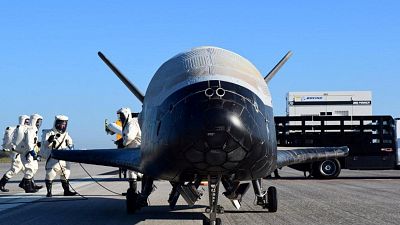
The U.S. military’s experimental X-37B space plane landed on Sunday at NASA’s Kennedy Space Center in Florida, completing a classified mission that lasted nearly two years, the Air Force said.
The unmanned X-37B, which resembles a miniature space shuttle, touched down at 7:47 a.m. EDT (1147 GMT) on a runway formerly used for landings of the now-mothballed space shuttles, the Air Force said in an email.
The Boeing-built space plane blasted off in May 2015 from nearby Cape Canaveral Air Force Station aboard an Atlas 5 rocket built by United Launch Alliance, a partnership between Lockheed Martin Corp and Boeing Co .
The X-37B, one of two in the Air Force fleet, conducted unspecified experiments for more than 700 days while in orbit. It was the fourth and lengthiest mission so far for the secretive program, managed by the Air Force Rapid Capabilities Office.
The Air Force intends to launch the fifth X-37B mission from Cape Canaveral Air Force Station, located just south of the Kennedy Space Center, later this year.
The space plane has been the object of frequent speculation about its potential military uses, particularly in either surveillance or some type of combat application, according to NPR.
The X-37B, one of two in the Air Force fleet, conducted unspecified experiments for more than 700 days while in orbit. It was the fourth and lengthiest mission so far for the secretive program, managed by the Air Force Rapid Capabilities Office, according to U.K’s publication Independent.
The publication further reports on it’s website that Secure World Foundation, a nonprofit group promoting the peaceful exploration of space, says the secrecy surrounding the X-37Bsuggests the presence of intelligence-related hardware being tested or evaluated aboard the craft. The vehicles are 29 feet long and have a wingspan of 15 feet, making them about one quarter of the size of the National Aeronautics and Space Administration’s now-retired space shuttles.
The X-37B, also known as Orbital Test Vehicle, or OTV, first flew in April 2010 and returned after eight months. A second mission launched in March 2011 and lasted 15 months, while a third took flight in December 2012 and returned after 22 months.






01:00
Pix of the Day, 10 September, 2026 - Across the world
Go to video
Nigeria confirms planned withdrawal of US troops sent to help tackle insecurity crisis
00:56
Former gang member found guilty of murdering Tupac Shakur
01:01
US due to cut off UAE branches of Egypt's Banque Misr over Iran ties
01:11
U.S. deports dozens to Haiti as migrants arrive in unfamiliar country
00:41
Qatar’s foreign minister visits Tehran as efforts to ease Iran-U.S. crisis continue