



Sudan
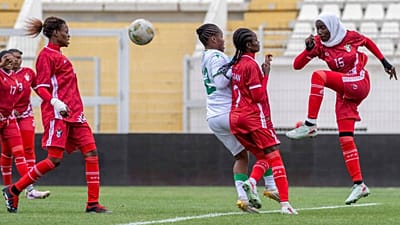
Their red jerseys stood out against the green pitch. Most were teenage girls. Some had fled war. Others had never played in an organized soccer league or set foot in a major stadium before.
Yet when they took the field at Larbi Zaouli Stadium in Casablanca, Morocco, they marked Sudan’s first appearance in international women’s soccer since a civil war erupted in a country where women’s participation in sports has long been controversial.
“My goal is to lift up soccer in my country,” Nura Mohamed, the 17-year-old team captain, told The Associated Press.
“It’s a beautiful, unique feeling because, at the end of the day, I just love playing.”
Sudan’s under-17 women’s national team traveled to Morocco last week for qualifying matches on the road to the 2028 Los Angeles Olympics. The inexperienced squad suffered heavy defeats against Comoros, conceding 30 goals in two matches.
Many of the players broke down in tears after the final whistle in front of a dozen cheering fans.
They faced an older, fitter, and more experienced opponent. Unable to assemble a senior women’s squad in time, Sudan’s soccer federation entered a younger team to avoid forfeiting its place in the qualifiers. They only started training weeks ago.
“The difference between us and the others is huge. We cannot yet compete at the highest level," Burhan Tia, a veteran Sudanese soccer coach who oversees all of Sudan’s women’s national teams, said after the first match, a 17–0 defeat.
“Comoros has many players competing in Europe, our team is mainly made up of schoolgirls."
This team represents hope for Sudan's future
Sudan’s women’s soccer collapsed when civil war erupted in 2023. For federation officials, debuting this young squad in Casablanca after years of conflict marks an important step in keeping women's soccer alive in Sudan.
“Some traveled long distances just to attend training. Many are separated from their families, yet they continue to work hard and pursue their dream," Manal Ali Bushra, a businesswoman who heads the women’s soccer committee, told the AP.
To support that vision, Ali Bushra said the federation is working on infrastructure projects, including a planned sports city and the renovation of key stadiums in safer parts of the country. She declined to answer questions about the women’s program budget and funds.
Tia knew the magnitude of the challenge when he accepted the job of rebuilding a shattered team.
“First, I had to find girls who played soccer. Then, once I found girls who played, I had to make sure they were the right age,” he said. “Then I needed to convince their parents to let them miss classes for training.”
With the league suspended, his scouting trips took him to schools across Sudan and to neighboring Egypt, where many families had fled the war. He recruited 10 players from teams and academies in Cairo, with the rest drawn from Sudanese cities.
Tia would have liked to recruit from conflict-hit areas like Darfur or Kordofan, a region known for producing Sudan’s top athletes. But many girls had lost their identification documents, making it impossible to verify their ages under international regulations.
The war has also shattered transportation, turning journeys between cities that once took hours into perilous trips lasting days.
On the field, the players’ lack of experience was evident. Several struggled with basic positioning, failing to hold the offside line or maintain tactical discipline. Throughout the matches, they repeatedly looked to the sidelines for instructions from the coach and his assistant.
Facing war, fatwas and conservatism
The United Nations has described the war in Sudan as the world’s worst humanitarian crisis. It began in 2023 when a power struggle between the military and the paramilitary Rapid Support Forces erupted into fighting marked by mass killings, rape and ethnic violence. More than 40,000 people have been killed, according to U.N. figures, and over 14 million have been displaced, with famine and disease spreading across parts of the country.
The war halted every sports activity, including the women’s soccer league, which was officially established after the 2019 progressive revolution that ousted President Omar al-Bashir. His three-decade Islamist rule was marked by Public Order Laws that rights groups said restricted women’s freedoms. Even after the revolution, prominent Sudanese preacher Abdulhay Yousif said the establishment of a women’s football league was aimed at undermining religion.
“The idea of women running, jumping, sweating, and even something as simple as their bodies being visible in motion, was seen by Bashir’s Islamist regime as producing fitna, which in a Sudanese context was understood as sexual or moral chaos,” Liv Tønnessen, a political scientist researching gender politics in Sudan, told the AP.
“So when women step onto a soccer pitch, they are directly confronting that entire logic. They are not just present in a male-dominated sports arena, they are moving freely in it, on their own terms,” Tønnessen, a former guest researcher in a women-only university in Sudan, added.
Beyond institutional hurdles, players also faced a wave of sexist abuse online. On the national team’s social media accounts, many commenters mocked them for big defeats. Others posted the phrase “go back to the kitchen,” in multiple languages.




00:56
Government of Equatorial Guinea submits collective resignation
01:51
Fear of Ebola keeps pregnant women away from hospitals in DR Congo
Go to video
Tunisia repatriates nearly 100 sub-Saharan migrants in 'voluntary return'
00:58
Ghana's Thomas Partey loses bid to enter Canada for World Cup
01:45
Ramaphosa defends South Africa amid rising anti-immigrant tensions
10:00
Kenya and France are organizing the Africa Forward 2026 summit [Africanews Today]