



Bees
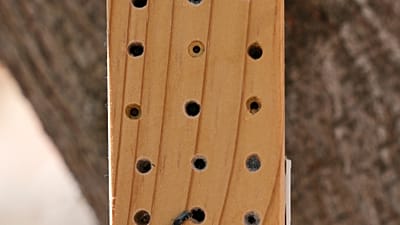
A tiny solitary bee disappears into one of the world’s smallest hotels: a little hole drilled into a box made of untreated pine.
At the University of the Witwatersrand, Sage Naidoo is keeping an eye on these miniature visitors.
He coordinates the South African campaign of UrbanBEE, a research project looking at the different species of solitary bees found in cities and how they adapt to urban life.
"What UrbanBEE is, is it's essentially looking at the diversity and the patterns of these solitary bees, and how they exist and interact within our urban environments, but also more importantly, how we can reconnect and re-engage people with nature. Because an important factor that we know through a lot of research that has come out is that. Urbanisation has decreased the amount of nature that's available to us on a daily basis. And so, what we're trying to do is find small-scale interventions that can help reconnect and re-engage people with biodiversity. And using bee hotels through citizen science, we thought this would be a good way to assess both an aspect of biodiversity that is not commonly well known," he explains.
The project brings together hundreds of volunteers across Johannesburg and Cape Town, each monitoring a wooden bee hotel and submitting regular photographs of its occupants.
Their observations are helping researchers understand how cities shape solitary bee populations, while exploring whether getting people involved in citizen science can bring them closer to nature.
Unlike the familiar honeybee, which live in managed colonies, most of the world's more than 20,000 known bee species are solitary.
South Africa alone is home to roughly 1,300 species, many of which nest underground or in cavities in wood and hollow stems.
“So we have the leafcutter bees. So these are ones that use plant material to seal the nests. And also, it's the one that our participants have really, really wanted to get, because they just look very pretty. And what you can see is, if a leafcutter enters your hotel, you'll typically see this bright pop of green, or they might use flower petals. So we have bright pops of purple, bright pops of red, that indicate that you have a leafcutter bee that has entered your hotel. We also have the carder bees, which are also known as mud bees. And they essentially use the mud from the ground to seal the hole. And you'll see different shades of mud being used to seal the hole," says Naidoo.
For Johannesburg banking analyst Celia Haupt, becoming a bee hotelier has meant learning to pay attention to the smallest details.
She is one of hundreds of volunteers who installed a hotel at home, documenting its arrivals and experimenting with the best conditions to attract guests.
Finding the right spot took some trial and error.
Eventually, she settled on a location that catches the morning sun, giving the bees warmth without exposing them to the harsher afternoon heat.
"So you may notice that the sun is coming onto my face and this is one of the beauties about this spot actually, gradually the sun comes here, it gives morning sun, and that's one of the good things about the location that you should put your bee hotel. They need warmth in the morning and then not too much warmth in the afternoon. Well, the afternoon sun's very, very hot, and I gather that's not so great. So around the experimentation around where we should put the bee hotel, it was to find this beautiful spot as the sun comes in in the morning and makes it nice and toasty and warm for the little bees," says Haupt.
For participants, the project has become about more than counting bees.
Haupt's hotel initially stood empty for weeks, as volunteers compared occupancy figures and shared the frustration of having no residents.
Weekly updates brought a sense of friendly rivalry, but also connected people who might otherwise never have crossed paths.
“It felt nice to be part of citizen science. I felt like it was valuable. We were doing something important, but also just part of a bigger community. Where I knew there were other people out there who were doing similar things, having the same angst about not having any residents in their bee hotel and the similar joy about getting a resident and then more residents," Haupt says.
For Guinivere Pedro, another Johannesburg participant, the experience has been life-changing.
"I think it changed my life and my perception of the world a lot to have a bee hotel and guests and that occupied. Of course, I haven't gotten rich off it, but the noticing of the small things has definitely enriched my life. I mean, I've gone for birding courses now, because just learning a little bit makes the world so much more playful. And I realised, the more you know, the more things you can put together, the more things you can story-build around a bee hotel. And, yeah, my brain finds these things very, very funny," she says.
The project has also encouraged participants to rethink how they use their outdoor spaces, making room for more flowers and leaving parts of their gardens undisturbed.
"What actually ended up happening is the diversity of my garden grew a lot. We were encouraged to plant flowers, and an abundant type of them, so that any bee can find something that it can pollinate and feed off. So, that was the explosion of colour that happened in my garden. So they've made my little space a little bigger," Pedro says.
UrbanBEE grew out of an earlier, pandemic-era initiative involving 347 Johannesburg residents, led by University of the Witwatersrand researcher Chevonne Reynolds.
Its expanded programme, funded by the European Union-backed Biodiversa+ partnership, now includes parallel studies in Budapest, Turin and Vienna.
Comparing hotels across African and European cities could show how climate, vegetation, development and socioeconomic conditions affect bee diversity - and how collecting data changes how people value urban nature.
“I hope that people just have a better appreciation of this diversity that exists around us and know that it's not always just what meets the eye. There's so much more diversity that we don't know about, that we don't actively see, that's still partaking within our environments at the exact same time that will give us an idea of what's happening in our environment. So, my hope is that also people will just be more actively engaged with nature, go outdoors, reconnect with the aspects of biodiversity that we've lost a connection to," says Naidoo.


02:20
Extreme heat threatens pregnant women in South Africa’s informal settlements
01:00
Pix of the Day, 26th November 2026: South Africa's Biovac bets on African vaccine production
00:51
South Africa's Ramaphosa wins court bid over impeachment report
01:06
South Africa's Ramaphosa says talks ongoing with US over AGOA exclusion
01:42
Memorial service honours late South African deputy president
01:08
Zimbabwe court issues arrest warrant for Robert Mugabe’s son